- 2nd September, 2026
- By Cameron Jamieson
LightWELD calibration, laser welding procedure qualification Australia, IPG LightWELD Australia, handheld laser welder power output
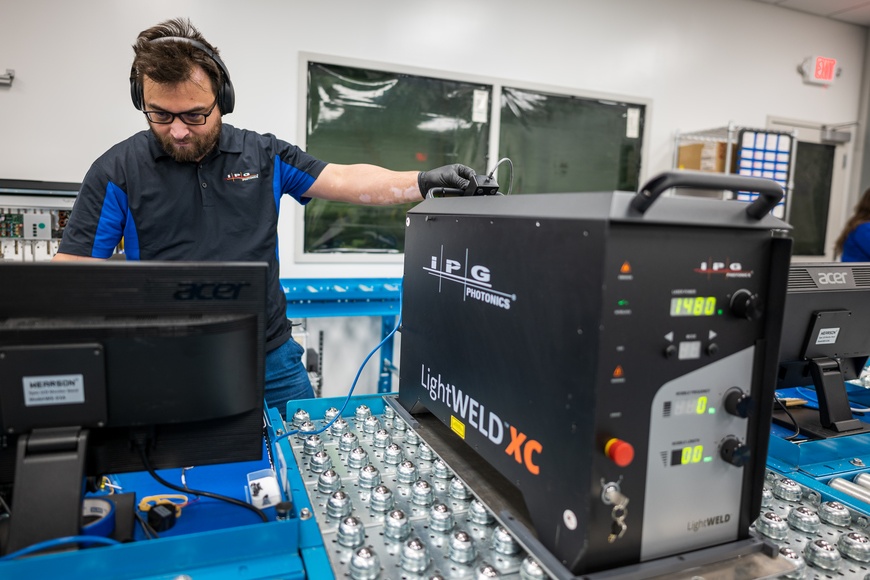
Why We Burn In Every LightWELD Before It Touches a WPS
Australia's only authorised IPG LightWELD dealer gets asked a version of this question most weeks: "We've already got a laser welder running — why does the second unit need its own commissioning?"
Fair question. Here's the honest answer, and it's got nothing to do with box-ticking.
Your machine is not the machine next to it
A laser welding system will tell you what it's outputting. The touchscreen says 70% power, the datasheet says the unit is rated to 1500W, and on paper that's exactly what you're getting. In practice, no two units — even two units of the identical model, off the same production line — deliver identical real-world power at the identical setting. Component tolerances, fibre coupling, optics, and how hard the diode pumps are being run all shift that number slightly, unit to unit.
That's not a LightWELD problem specifically — it's a laser problem, full stop. But it's a problem almost nobody talks about, because most operators never have a reason to find out their machine's actual output has drifted from what the panel says.
Weld shops running to a documented procedure do have a reason to find out. And this is where it actually bites.
A WPS is a recipe for a specific machine, not a brand
Under ISO 15614-11 and AS/NZS 9606-1, a Welding Procedure Specification is qualified against real test welds — destructive and non-destructive testing, on a specific setup, with specific equipment. Our own standards reference material puts it plainly: standards qualify the resulting weld, not the equipment used to produce it.
The flip side of that is the part people miss: if the equipment producing the weld changes — even to another unit of the same model — the procedure you qualified is only as good as the assumption that machine #2 is putting out exactly what machine #1 put out at the same setting. If it isn't, you don't have a qualified procedure anymore. You have a documented set of dial positions that happened to work on one specific machine, on one specific day.
That's the reason we don't let a customer lock in a WPS off day-one, out-of-the-box numbers — on any brand, any model. You qualify a procedure against verified, stable output, not against what the screen says an hour after unboxing.
Why the burn-in is 5 hours, not 5 minutes
Every LightWELD we commission goes through a burn-in and calibration check before it's handed over as production-ready — roughly five hours of continuous, monitored running before we're comfortable calling the output numbers stable enough to build a procedure against.
Two things happen in that window:
It screens out early-life faults. Any component with a manufacturing defect — fibre coupling, connector, diode — is far more likely to show up in the first few hours of real running than after months of light use. This is standard practice in laser diode manufacturing generally: burn-in exists specifically to catch the units that would have failed early, before they're in a customer's hands. Better it shows up on our bench in Hallam than on your shop floor mid-weld.
It gives you a true baseline, not a day-one number. Output on any laser system settles slightly as it comes up to normal operating temperature and the optical path stabilises. Calibrating and recording power output before that settling has happened is calibrating against a number that's already about to move. Five hours in, what you're recording is the number the machine will actually hold — which is the number your WPS should be built on.
Why IPG's diode pumps hold that number longer
This is the part that matters most once the machine is in production, not just at commissioning.
IPG runs its LightWELD diode pumps at roughly 85% of rated capacity to deliver spec'd output. A lot of the imported and lower-cost handheld systems on the market run their pump diodes much closer to the ceiling — up around, or even past, 100% of rated capacity — to hit the same headline power number on a spec sheet.
On a datasheet, that difference is invisible. Both machines say the same wattage. In service, it isn't invisible at all. A diode running near its rated limit runs hotter, degrades faster, and loses output over its working life measurably sooner than one running with headroom underneath it. That's not a LightWELD-specific claim — it's basic diode reliability engineering: the further a diode runs from its ceiling, the longer it holds its rated performance before it starts to droop.
Put those two things together and you get the actual, practical reason machine-to-machine calibration matters over the life of the unit, not just on day one:
- A machine with diode pumps running near their ceiling will drift off its qualified output faster — so a WPS built on it has a shorter useful life before it needs re-verifying, whether anyone's tracking that or not.
- A machine with the kind of headroom IPG builds in holds its calibrated output longer — so the procedure you qualified against it stays valid for longer, without the shop floor even knowing there was ever a risk.
That's not a marketing line. It's the reason a laser welding investment with the right engineering behind it protects your compliance paperwork as well as your production line.
What this means for your shop
If welds coming off your laser welder need to stand up to a WPS — AS/NZS 1554, AS 4041 piping, ASME BPVC Section IX QW-358, whatever code applies to your work — the machine's calibration isn't a one-off event. It's the foundation the whole procedure sits on, and it's only as solid as the headroom the equipment was built with and the discipline of whoever commissioned it.
That's the case for a 5-hour burn-in before a new unit goes near a live job. It's also the case for knowing who built your machine's diode pumps to run with margin, not against the ceiling — and who can put a technician on your floor in Melbourne, not a call centre overseas, if that calibration ever needs checking again.
Industrial Laser Solutions is Australia's, New Zealand and SEA only authorised IPG LightWELD dealer — commissioned, serviced, and repaired in our own Melbourne workshop, not sent offshore.
Want your next unit commissioned properly, or your current one's calibration checked before your next WPS review?
lightweld.com.au | 03 9796 3055 | Sales@industriallaser.com.au